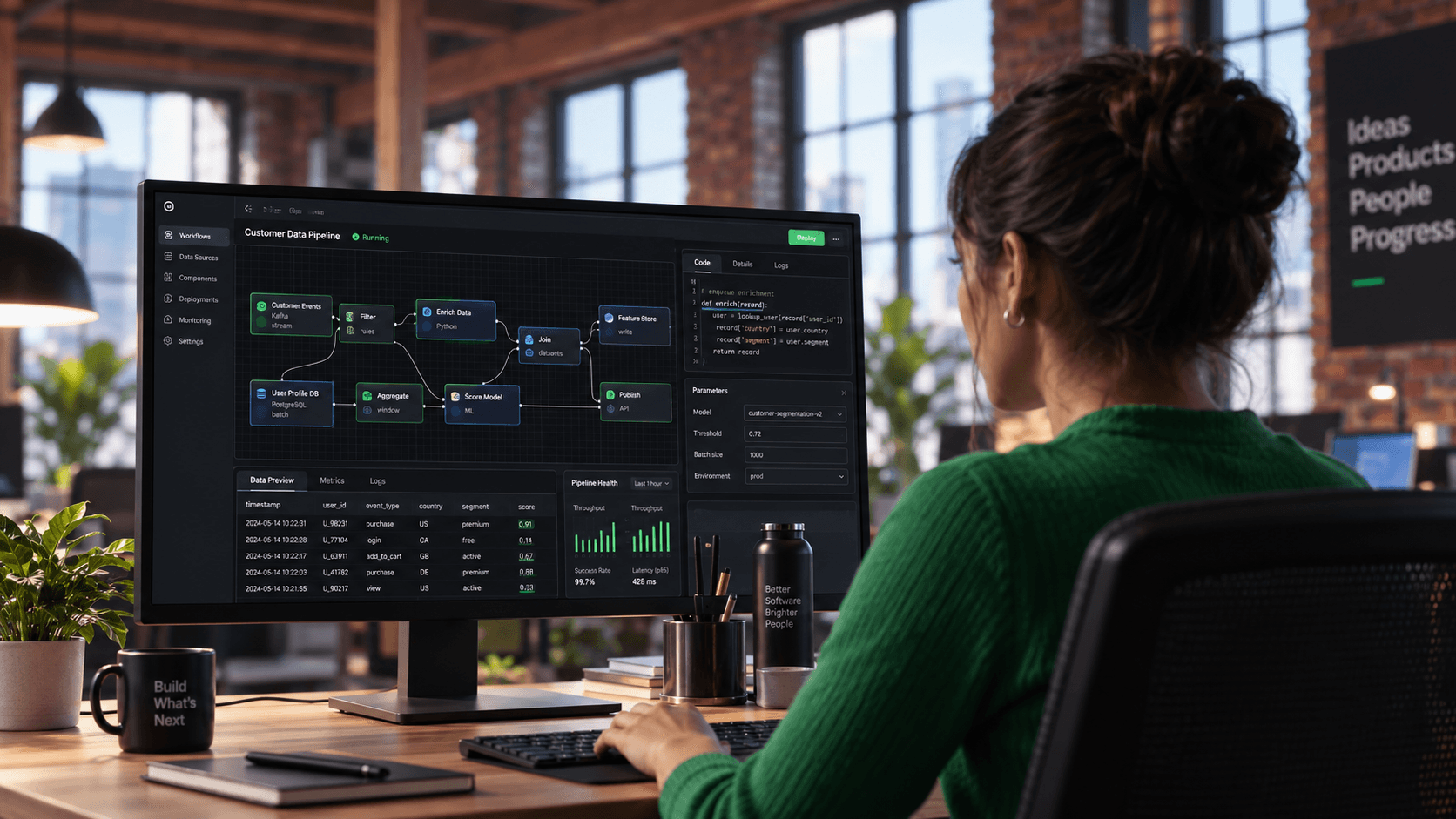
Your pull requests catch errors too late. Here's where AI code review belongs.
Most engineering teams still find their errors in the pull request, days after the code was written. This piece explains why that timing is the real cost, and how rules, pre-commit checks, and AI code review move quality to the moment code is saved.

Most engineering teams find their errors in the pull request, days after the code was written. By then the author has moved on, the reviewer is spending attention on formatting instead of design, and every fix costs a context switch.
AI code review helps only when it is one layer in a process that checks quality at the moment code is saved. That process has four parts: clear business rules before the first line of code, one shared coding standard, automated tests that block a bad change locally, and an AI second look before any human reviews the work.
This is how Tekton builds software today, not a future roadmap. Below: why late errors are expensive, what changes when checks move before the PR, where AI earns its place and where it doesn't, and the design principles that keep one change from spreading across services.
Why errors surface at the pull request, days too late
In most teams, the pull request is the first real quality gate. Code gets written, saved, and pushed with no checks in between. The first person to say something is wrong is usually the tech lead or a peer, sometimes days later.
That timing creates three costs. The author has to reload context they already dropped. The reviewer burns time on naming, formatting, and missing tests that a machine could have flagged in seconds. And approval turns into rounds of comments that end late, with everyone tired, on questions of form rather than substance.
AI-assisted software development makes this worse before it makes it better. Teams now generate more code, faster, and the review queue absorbs the difference. The 2025 Stack Overflow Developer Survey found that 84% of developers use or plan to use AI tools, yet 46% distrust the accuracy of the output, and 66% say their top frustration is AI answers that are "almost right, but not quite." Almost-right code is exactly what a tired reviewer misses.
What changes when quality checks move before the PR
Shift-left testing doesn't just add steps. It changes the order in which problems get found, so the cheapest checks run first and humans see only what machines couldn't resolve.
Stage | Before | After |
| Definition | Code gets written directly | Clear business rules exist before the first line |
| Development | Each engineer follows personal habits | An AI agent writes code against one shared standard |
| First check | Changes are saved with no check | Pre-commit checks run feature tests against local mocks and block the change if logic or contracts fail |
| Review | The tech lead or a peer spots errors first | AI code review gives a second look before a human sees it |
| Build | No targeted build | Only what changed is built and tested, automatically |
| Approval | Rounds of comments; approved late, with friction | The tech lead decides on substance, not form |
The result is not less human review. It's human review that stops spending itself on what an automated check could settle in seconds. This mirrors what the NIST Secure Software Development Framework (SP 800-218) already asks of mature teams: code review and analysis against the organization's own coding standards, with automated testing built into the pipeline.
Where AI code review fits, and where it doesn't
AI code review is a second look, not a final approval. It is good at catching deviations from an agreed standard, missing tests, and patterns that break team conventions. It is weak at judging whether a design fits the business, which is the part only people who know the domain can answer.
The 2025 DORA State of AI-assisted Software Development report, based on nearly 5,000 technology professionals, describes AI as an amplifier: it magnifies the strengths of disciplined teams and the dysfunctions of struggling ones. The same report found AI now raises delivery throughput but still increases instability. Speed without guardrails ships problems faster.
That is why the order matters. Rules and standards come first, so the AI agent has something concrete to follow. Automated pre-commit checks come second, so obvious failures never reach review. AI code review comes third. The human reviewer comes last, focused on what Google's engineering practices put at the top of any review: design and functionality, not style.
Testing feature behavior locally before code reaches the evaluator
An AI evaluator provides real value when it moves beyond syntax and formatting to validate functional behavior. For a feature or fix to be effectively evaluated before a pull request, the local pipeline should run feature-level integration tests against isolated environments. By leveraging local mocks, stubs, or test doubles for external services (such as third-party APIs or databases), developers and AI agents can execute tests deterministically in seconds. This ensures that the code doesn't just look right, it proves that the business logic works as intended before any human review takes place.
We've written before about why human-in-the-loop AI development separates software that looks finished from software that survives production. AI code review is the same principle applied inside the development loop.
The design principles that stop one change from breaking five services
Automated checks catch errors in a single change. Architecture decides how far an error travels. With high coupling, one change spreads to every service that shares the dependency. With low coupling and high cohesion, it stays in the service that caused it. Five principles make that hold in practice:
- Architectural consistency. Independent services built with the same internal structure (controller, service interface, repository) don't lower runtime coupling, but they do lower cognitive load. Nobody learns a new style for every service they touch, and an AI agent has one pattern to follow.
- Interface segregation. No client should depend on something it doesn't use. A dedicated projection per service, instead of one shared data model, avoids tying services together through dependencies they never needed.
- API contracts. What a service exposes is a contract, not an internal detail. A change there stays contained only if the published contract is updated together with the implementation.
- Self-documenting code. The code is the single source of truth. A legitimate comment explains a fact you can verify right there, without depending on a ticket or a chat thread that may disappear.
- Team-agreed coding standards. A new convention in one file doesn't improve the whole. It creates a second dialect. Changing a convention is a team decision, not a file decision.
These principles matter more with AI in the loop, not less. An agent that follows a clear standard produces consistent code; an agent working in an inconsistent codebase reproduces the inconsistency at speed. As we argued in Your Engineers Aren't Slow. Your Architecture Is, AI-driven development exposes architectural limits instead of compensating for them.
What this changes for architecture leads, product owners, and leadership
Moving quality before the pull request produces four concrete effects: errors show up when a change is saved, not days later in review; the same quality standard applies across the project regardless of who codes that day; an AI reviews the work before the tech lead does; and what was requested stays traceable to what was built, end to end.
For an architecture committee, the quality standard stops living in one person's memory. It lives in the process and applies the same way across every service.
For a product owner, what was requested and what was built are born together. What gets approved is, verifiably, what ends up working.
For stakeholders and leadership, the cost of an error is paid in seconds on the developer's machine, not weeks later in production.
Is your team ready to add AI code review?
Answer these before adding another AI tool to the pipeline:
- Are business rules written down before development starts?
- Is there one coding standard the whole team agreed to, not one per service?
- Do tests run automatically, and do they block a change locally when they fail?
- Are API contracts published and updated together with the code?
- Does the tech lead's review time go mostly to design, or mostly to formatting?
If any answer is no, fix that layer first. AI code review on top of an inconsistent process gives you faster inconsistency.
Intelligent ecosystems are built, not assembled. Quality is one of the things you build in, from the first rule to the last merge. See how Tekton approaches AI-native software development, explore our client case studies, or review our full service lines to scope where your delivery process stands today.
Frequently asked questions
AI code review uses an AI model to inspect a code change before a human reviewer sees it. It flags deviations from the team's coding standards, missing tests, and risky patterns, so the human review can focus on design and business logic.
No. AI code review is a second look, not an approval. It handles checks of form and consistency; the tech lead still decides whether a change is right for the product and the architecture.
Shift-left testing means running quality checks as early as possible in development, ideally when code is saved. Pre-commit checks run tests locally and block a change that fails, so errors surface in seconds instead of days later in the pull request.
At minimum: automated unit tests, a style and lint check against the team's agreed standard, and a build of only what changed. An AI second look can follow, before any human reviewer is assigned.
AI speeds up how much code gets written, so it also speeds up how far a mistake can travel. Low coupling keeps a change contained to the service that caused it, and consistent structure gives the AI agent one pattern to follow.
Write the standard down, agree on it as a team, and enforce it automatically. The AI agent follows that standard, pre-commit checks verify it, and changes to the convention are team decisions, never single-file exceptions.